
Wednesday, April 04, 2007

News and Notes

150 days until football season. Basically, we have the spring games and then things get really bleak. To tide us over in advance of some final football thoughts, here's a few random thoughts on the week's events so far:

Iranian President Mahmoud Ahmadinejad says Iran will release the 15 detained British sailors and marines "as a gift to the British people." In other news, I'm off to rob Goodwill, but rest assured I'll return the loot in a few weeks as a gift and, yes, I will be seeking a deduction next April 15. While the U.S. is not yet at war with Iran, apparently the race is on between our leaders to who can be the smuggest SOB alive not named Trump. Ahmadeinejad jumped out to a big lead this week, magnanimously asking British PM Tony Blair not to "punish" the crew for confessing they had been in Iranian waters when they were seized by Iranian coast guard. To make sure its stick landed squarely in Britain's eye, Iran broadcast videotaped confessions by crew members. (Image at right: Ahmadinejad, apparently in his hostage-taking salad days during the 1979 seizure of the U.S. embassy in Tehran.)

Keith Richards may or may not have snorted his dad's ashes. If it's true, the only thing surprising about this is that it wasn't Ozzy Osbourne. But Keef has gotta make anyone's short list of people who would do this kind of thing. That list would also include Lemmy Kilmister.

The NCAAs are over, but Billy Packer won't go quietly. Appearing on the Charlie Rose Show, CBS men's hoops color man/lightning rod for scorn, ridicule and hate! hate! hate!, Billy Packer, whose name is Packer, tells Rose, "you always fag out," in response to Rose's mock offer to help him out during the tournament. Consensus is that Packer was not using British slang for cigarettes, because a) Packer is not British and b) "you always cigarette out" makes absolutely no sense. Really, I thought the "Henderson was not looking for a cheap shot" call of the Tyler Hansbrough mugging was going to be Packer's nadir this season, although his insistence on mispronouncing Florida coach Billy Donovan's name ("Dunnavan") during the entire NCAA championship game has to make the season's top 10. Damn you, Packer, the whole point of this post was to see if I could make it through the day without mentioning the Gators.

EMI will be selling high-bitrate, DRM-free downloads through iTunes for $1.30 apiece. The chorus of DRM haters ought to include anyone with more than a two-digit IQ, which apparently excludes most major label executives. EMI Group CEO Eric Nicoli, whom I took to task over a year ago, has finally acknowledged a least a small portion of the insanity that is Digital Rights Management. To recap, the lack of interoperability has inhibited digital music sales growth while CD sales continue to falter and placed content owners (the labels) squarely under the thumb of Apple's near-monopoly. Moreover, DRM means limiting consumer options, as in the number of devices on which a consumer can play a track and how many times he/she can copy it. Options have value, which is why we have the Black-Scholes Model. Apparently, EMI and Apple think options in the digital music realm are worth 30 cents a track, as the DRM-free tracks will be priced at $1.30. Lifting DRM restrictions eases some of the pains I mentioned, although these tracks, which are encoded at 256 kbps, will be initially available exclusively though … iTunes. EMI stressed that DRM would remain on music bought under monthly flat-fee-based services such as Rhapsody, Napster and Yahoo Music Unlimited. Oh, well. Baby steps.

Labels: , , ,

Thursday, March 29, 2007

Hybrids Approach Parity

John Gartner reports in today's "Autopia" blog on Wired that hybrids could become a good buy for consumers in the next two years, thanks to innovations in lithium ion batteries. These batteries are 35 percent lighter and 55 percent smaller than nickel metal hydride batteries, and enable vehicle manufacturers to cut the price delta by half. Granted, this post was prompted by a bit of shilling on the part of Charles Gassenheimer, the Vice Chairman of Ener1 Inc., which develops lithium ion batteries.

Even still, this topic has been of immense interest to me and anyone else who'd like to see consumers, the economy and the environment all get out from under the thumb of Big Oil. In business school, we spent a lot of time on cases involving alternative energy startups and the product roadmap for hybrid and other low-consumption vehicles. While many of us argued the point that we'd rather pay a premium to Toyota or Honda than to Exxon, ultimately, we came back to the sad conclusion that consumers will always vote with their wallets.

After grinding a few of the data points in Gartner's post, I've found there's reason to be more optimistic. Currently, car buyers pay a $4,000 premium for a hybrid car over the equivalent gas car. Assuming the average motorist drives 12,000 miles a year and pays the current average fuel cost of $2.581 a gallon, it would take nearly six and a half years for the fuel savings to catch up with the premium one pays for a hybrid car. Given that most people sell their cars after five years, there's not a strong financial value proposition for hybrid cars currently. These are my calcs:


Hybrid

Regular

Mileage

50

25

Premium

$4,000.00

$0.00

Miles/Year

12,000

12,000

Gallons purchased

240

480

Fuel cost

$2.58

$2.58

Annual fuel cost

$619.44

$1,238.88

Years to break even

6.46

6.46

Total Fuel Cost + Premium

$8,000.00

$8,000.00


But, if Gassenheimer's prediction holds true, hybrid car buyers would need less than three years and three months to break even. That's well within the five-year window in which most people keep new cars and thus shows a very reasonable financial value prop. Of course, true finance geeks will haggle about time value of money, but since you'd have to apply that to both the up-front cost of a hybrid and the added fuel costs of a gas car, I think it comes close to being a wash.


Hybrid

Regular

Mileage

50

25

Premium

$2,000.00

$0.00

Miles/Year

12,000

12,000

Gallons purchased

240

480

Fuel cost

$2.58

$2.58

Annual fuel cost

$619.44

$1,238.88

Years to break even

3.23

3.23

Total Fuel Cost + Premium

$4,000.00

$4,000.00

Labels: ,

Friday, March 23, 2007

Friday Breakfast Taco

Today's breakfast taco is brought to you by Juanita's, the little red caboose on 5th. The egg and chorizo is solid and the salsa verde is among my favorites in Austin.

Soundtrack: I Do Not Play No Rock 'N' Roll, by Mississippi Fred McDowell. North Mississippi Hill Country Blues earliest exponent plugs in electric for the first time and features a rhythm section comprising more than his foot and right hand (it's some dude with brushes barely audible in the background). As the title indicates, this ain't no sell-out. Aside from a little amplification, it's the same straight, rhythmic, droning deep blues McDowell had been playing since the '20s (although that's a matter of faith, as it wasn't until 1959 when folklorist Alan Lomax became the first to capture McDowell on tape). The Stones turned in very faithful cover of "You Got to Move" on Sticky Fingers. The album also features a rollicking "Jesus is on the Mainline" and a jagged, slashing "61 Highway." McDowell died two years after this album's release (1969) of cancer.

Vote Different: Several versions of the mash-up of Apple's 1984 Super Bowl ad attacking Hilary Clinton are circulating on YouTube. Per Wired, the original is the product of Phillip de Vellis, an employee of Blue State Digital, a political technology consulting firm whose clients include Democrats Barack Obama, Bill Richardson and Tom Vilsack. De Vellis revealed himself in the Huffington Post, noting that he supports Obama's presidential candidacy, but that he made the video independent of his employer, "on a Sunday afternoon in my apartment using my personal equipment (a Mac and some software)" and then uploaded it to YouTube and e-mailed links to blogs. Accounts differ whether de Vellis was fired or resigned, but, either way, he's no longer with Blue State Digital.

The message was brilliantly executed: Clinton gives her candidacy speech from a giant telescreen from George Orwell's novel 1984, promising to "let the conversation begin," a conversation that de Vellis apparently believes is really a monologue.

At issue is whether the Federal Election Commission should be monitoring this kind of activity, to see whether large corporations, unions and other groups are unfairly influencing elections by bankrolling viral Internet campaigns – basically, creating an online wave of Swiftboat-esque campaigns. When you think ahead to what well-funded ad agencies, cashing checks from the RNC or DNC, could do with this medium, I suppose regulation of the public airwaves could resemble deck chair arrangement on the Titanic. That said, the Internet is not a public commons, like the airways, so you have to factor in free speech considerations.

Still, I think the other takeaway here is how easy this apparently was and what a landmark moment this may well have been for social media and user generated content. I'm guessing de Vellis didn't get any clearances from Apple to use the original 1984-themed Super Bowl ad. He just grabbed some content that was freely available on YouTube and spliced it up to suit his own purposes. Clearly, he didn't need a Madison Avenue budget and Big Oil dollars to pull this off; all it cost him was a few hours of his weekend. Contrast that with Swiftboat, which was a massively coordinated campaign that entailed a lot of pricey media buying.

Granted, this wasn't a true populist uprising, as de Vellis is – or was – a part of the political machine when he produced "Vote Different." But this could have just as easily been done by someone outside of the political machine. De Vellis made an eloquent statement about how, using a few free online tools (and with a cavalier attitude about copyright), anyone – not just a Karl Rove-esque Svengali – can reshape the "conversation" Ms. Clinton, like everyone else in our two-party charade of a democracy, had expected to control.

Oh, yeah: I'm way, way, waaaay overdue on this, but I want to share my appreciation for some recent hat tips from T. Kyle King at Dawgsports and Senator Blutarsky at Get the Picture. Both of these guys do phenomenal jobs covering college sports from a Dawg's-eye view, delivering thoughtful analysis wrapped in clever, incisive writing that invariably rewards a visit several times over. And, particularly with the addition of MaconDawg over at Dawgsports, they're prolific enough to keep your RSS reader busy all day. Gents, if you want to use that as testimonial, have at it -- it applies equally and fully to all parties. Thanks again for directing a portion of your well-deserved traffic to my dark corner.

Labels: , , , , ,

Monday, February 19, 2007

Sirius and XM “merge” for $13B

Per this press release, the two cash-hemorrhaging satellite radio giants are combining in a tax-free, all-stock "merger of equals." I use quotes here because there's no such thing as a merger of equals. We know Sirius is the de facto acquirer because XM stockholders will be paid in Sirius stock and Sirius CEO Mel Karmazin will be the CEO of the new entity. Yes, XM Chairman Gary Parsons will be chairman of the new company, but that's getting into the realm of splitting hairs.

So is this a good thing?

From a consumer perspective: As a subscriber to neither of these offerings, I'm glad to be relieved of going through the tradeoffs between the two. I'm sure the cost of a subscription will go up, but having all of that content under one roof will be a good thing, although I'm sure there'll be a reduction of content where there are overlaps. Plus, the additional bandwidth could be used either to improve existing channels (I understand there's some noticeable compression for music channels), create new channels or add more interactive features.

From a stockholder perspective: The press release says analysts project $3B-$7B in cost synergies and, presumably a few of those analysts worked for the investment banks who earned a percentage on this deal. Still, obviously there's got to be quite a mother lode of synergies between two companies as asset-intensive as these. Per the terms, XM investors get 4.6 shares of Sirius for every XM share they own. Currently, XM shares are trading at $13.98 and Sirius shares are trading at $3.70, so, if the effective date were today, XM investors would be getting $17.02 apiece for their shares, which is a 22% premium. Not bad for a company that lost $666.72M last year. For investors in Sirius, which lost $863M last year, I dunno, I'd tolerate quite a bit of dilution if you could eliminate my only direct competitor and get even a billion in red off my income statement.

From a regulatory perspective: Depending on how you define the market and its competitors, this could reek of monopoly. But the fact is that there are still countless other ways to get radio content – for free. Plus, mobile devices such as iPods can carry free and subscription syndicated content in the form of podcasts. And, unlike satellite radio, you can listen to your iPod at 30,000 feet or in a tunnel. Sirius and XM have known for a long time that they were competing with a much larger universe than simply companies who can afford to broadcast from space. Frankly, if these companies aren't allowed to merge, it's not clear to me how they're supposed to survive without seriously jacking up subscription costs, which would probably kill them as well.

Labels: ,

Thursday, September 08, 2005

Mobile Communities

I have a natural bias towards community building, particularly in the virtual space. People are inherently social creatures and we use the web to connect with one another and trade information. Content is the one of the dominant currencies for this exchange. (And no, I'm not pretending that any the preceding bears the faintest trace of original thought.)

So, when Apple took the lid off of one of the worst-kept secrets in technology this week about the launch of the iTunes-enabled ROKR E1 phone and the iPod Nano, I confess to having expected more.

What’s really new here? That music is being digitized and made portable on smaller and smaller devices? Certainly not. Is it that music is moving towards distribution via wireless networks? Not really. People have been downloading ringtones, games and other forms of content onto their phones for awhile now. Satellite radio has been available on portable devices for several years.

So what we have with yesterday’s announcement is another pair of devices that give individual consumers another one-way interaction with a centralized content source. And that is no longer “breathtaking,” to borrow Steve Jobs’ description of the Nano.

Smaller size and new features aside, the only thing that is fundamentally different about the iTunes-iPod model since its launch is the introduction of the Podcast, which was not an Apple innovation.

The genius of the Podcast is that it allows consumers to use Apple’s iPod-iTunes platform as the foundation for connecting with one another, sharing preferences and building a community. The format allows users to publicly recognize content they believe is worthy and to be creative about how they do so.

By featuring Podcasts, the iTunes interface advanced on the web browser as an essential tool with which consumers interact with other consumers via the World Wide Web. In essence, it was a step from B2C to C2C, or C2B2C. Such steps are what allow companies such as eBay, Yahoo! and Amazon.com gain strangleholds over their markets and preserve margins.

In light of the cult that comprises much of Apple’s consumer base, I’m certainly not suggesting that Apple doesn’t appreciate communities. The conundrum Apple faces is that the iPod is anything but a social tool. If it were, perhaps they’d call it a wePod. As it stands, white earbuds have become the universal signal for one tuning out the world. The challenge to Apple is, now that there’s a large base of iPod owners out there, what will it take to get these people interacting on the basis of their iPod ownership? If p2p is a dirty term, then how about pod2pod?

The ROKR E1 is a potential answer to this challenge, but not in its current architecture. Presently, this is an iPod that you can talk on. (As an aside, I wonder what the airlines think of this. Can you have the music function on and the phone part disabled?) I’m sure that, in future iterations, that you will be able to download directly to the phone, rather than having to connect it to your computer. But the elephant in the living room is this: Phones’ fundamental functionality is p2p. We use them to engage the world, rather than to wall ourselves off from it.

And music doesn’t have to be wall. It can be a bridge. For example, wouldn’t it be cool to be able to listen to the music or podcasts of everyone on your call list or of every ROKR E1 owner in the vicinity? Or to view the video content of the same groups? Think about the kind of discovery (read: sales) that could be facilitated by such a model.

It’s not just music, as many Podcasts contain little to no music. When you connect the dots among blogs, podcasts and camera phones, you see that there is a new New Journalism evolving, where users are becoming citizen journalists, using interactive devices and media to paste together collages of text, video and audio to share with whoever is logged on. Devices such as the ROKR possess a unique capacity for producing, distributing and receiving such user-developed content. If Apple can look beyond the short-term goal of hooking users on the Apple interface, Apple could position itself as the nexus for such sharing.

Labels: ,

Tuesday, August 30, 2005

Goin' Mobile

Several developments this week gave us the best glimpse yet of how quickly digital music is going mobile – or, more specifically, cellular.

The first was a deal between major label Sony BMG and mobile phone network 3 to sell music to mobile phones. According to The Guardian, “The move is yet another attempt by an operator to persuade customers to do more with their phones than just talk and send texts. It also represents part of the industry’s efforts to turn mobile phones into digital music players and usurp gadgets such as the iPod.”

Analysts are predicting that mobile phone music downloads will overtake computer-based digital music services.

Perhaps hedging its bets, Apple is apparently set to launch a cell phone through Cingular Wireless and manufactured by Motorola that can play iTunes music, Ovum research analyst Roger Entner told the Associated Press.

It’s not known whether the new phone will allow users to download music directly over a cellular Internet connection or if users would be forced to download songs to a computer and then transfer them to the device.

As low-power, dual-core “cool” chips proliferate, there’s little doubt that mobile phones will be able to juggle the duties of an iPod and a Treo and increasing hope that their batteries can supply the energy demanded by such functionality.

Either discouraged by this trend or finally conceding its battle with the iPod, D&M Holdings, Inc., maker of Rio, the first digital music player, is getting out of the game, effective Sept. 30. D&M says the mass-market portable digital music player didn’t fit with its strategy of premium electronics brands, which include Denon, Marantz and McIntosh. Last month, it sold some mp3 player assets to chip maker SigmaTel.

The company blames the Rio for its losses, which widened to ¥717 million for the quarter ending June 30 from ¥530 million for the same quarter a year ago. Over the same period, sales fell to ¥18.75 billion from ¥19.22 billion.

Meanwhile, back on the services ranch, research firm Parks Associates released a study that concluded that 41% of people with digital music players are unwilling to pay more than $10 a month to listen to music. Yahoo charges $60 a year or $10 a month, while rivals Napster and Real Networks charge $14.95 a month.

“Companies like Yahoo! can afford to keep the price low because they have other revenue streams to subsidize their music services,” Parks analyst Harry Wang told TechWeb. “Pure-plays like Napster may not be able to lower their prices.”

Perhaps not, but, assuming Napster and Yahoo!’s music services are working on similar cost structures, I’d be curious to see how long Yahoo! would or could subsidize a business whose margins are, Wang implies, low to non-existent.

Subscription services may bear out Parks’ Parks’ $10 per month per consumer metric, but a la carte sales fall far shy of this number. Using Parks’ number, we would expect iPod owners (who account for 80% of all digital music player owners) to buy about 12 albums apiece this year on iTunes ($10/month --> 10 songs --> 1 album/month or 12 albums/year). With iPod sales at 20 million so far, that would put iTunes’ gross at $240 million for the year.

As it stands, with iTunes’ sales at $500 million since its inception, Apple has sold an average of 25 songs per iPod owner, grossing $24.75 per owner and netting $8.66 (if we assume the 65% payout to labels that iTunes was paying until last month).

Labels: ,

Tuesday, August 23, 2005

Unwinding iTunes/iPod, pt. 2

This Reuters story touches on issues I addressed last month (“Should Apple open its music format”), albeit from the perspective of content owners, rather than from Apple’s.

Essentially, record labels are chafing under the lock-in between iTunes and iPod, which prevents owners of the dominant music player from playing songs downloaded from services other than iTunes.

Reuters says that Apple commands 80% of the MP3 player market and 75% of online music sales. Industry analysts doubt that iTunes can sustain that kind of dominance and label execs worry that the music service cannot, by itself, carry digital music sales to the desired 25% of overall music sales by 2009. Piper Jaffray estimates that only nine tracks are bought per month per iPod user.

So the labels want Apple to un-bundle iTunes and iPod, to level the playing field for other music services. In a sense, iPod’s dominance gives iTunes a near-monopolistic advantage over its competitors. Apple, it seems, isn’t budging.

“It's a monologue with them,” Reuters quotes one unnamed label executive. “They pretty much say, ‘This is what we want to do,’ and if you disagree with them you’re an idiot. It’s like dealing with a cult.”

Reading between the lines, it’s easy to sympathize with both sides. If you’re a label, you want enough diversity among your retailers so that none has the leverage over you that Apple currently has over the labels.

Conversely, asking Apple to unwind iPod and iTunes is like asking Gillette to make razors that work with blades made by Schick or asking Hewlett-Packard to make printers that accept ink cartridges made by Dell.

Pending the re-launch of Connect, Sony will be one of very few companies with a hardware/service combo to compete with Apple’s. But as long as Sony’s music files rely on Microsoft’s Windows Media (.wma) file format, Sony won’t have the barrier to entry (in the form of a proprietary file format) that Apple enjoys with AAC++. Instead, Sony’s files can be supported on non-Sony devices and its device will support non-Connect files.

Absent some sort of incentives from content holders to induce Apple to unwind iTunes/iPod, there’s always hardball. Already bothered about perceived inflexibility on track pricing and promotions, labels could withhold content from Apple or give better terms to Apple competitors such as Sony, which, conveniently, is also a content owner.

Technology journalist Sandy Murray has posted an interesting piece on Corante.com that offers several strong rebuttals to the labels’ demands.

“If iPods supported secure Windows Media files, it would doom the AAC file format and place Microsoft in the driver’s seat,” Murray writes. “Do label executives really think they would be better off if Microsoft was the dominant player in music downloads?”

Murray is also bearish about Sony’s chances:

“Sony can’t control the market as long as the Connect store relies on Microsoft's Windows Media file format,” he says.

Labels: ,

Thursday, August 04, 2005

Is Google being out-Froogled?

I guess we should’ve seen this coming from a mile away: Audio search engines.

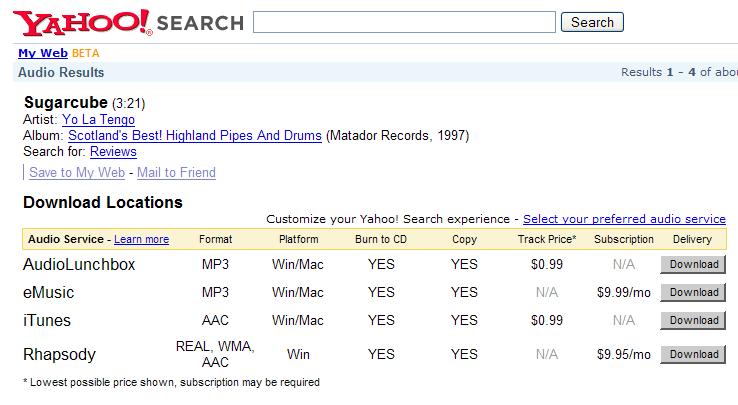
Just recently, Yahoo! launched a beta version of its Audio Search, which allows you to search for music, podcasts, sound effects, interviews, e-Books and speeches. After it returns an index of services that sell the file you’ve searched for, you click “download” and are immediately directed to the web page from which you can download the track. The index tells you what formats, platforms and prices go with each service, as well as whether you can copy or burn a file from each service.

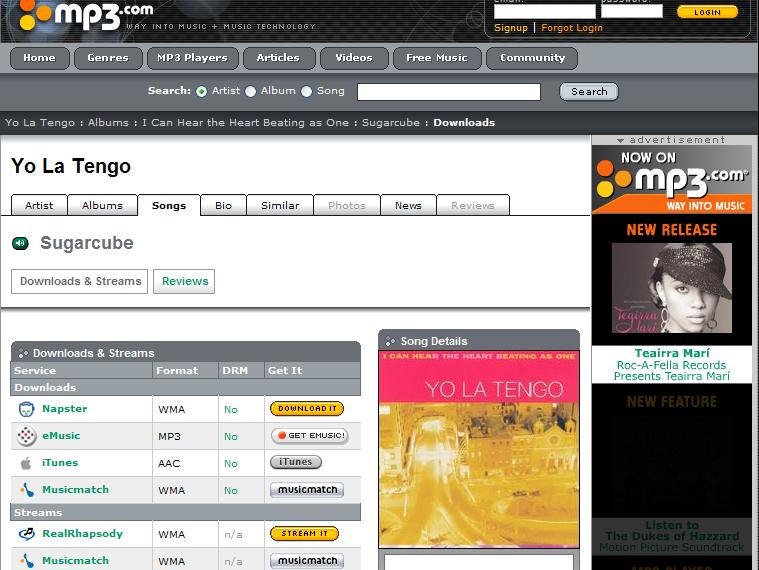
Mp3.com offers a similar service that directs you to downloads and streams and tells you what format each service uses and whether the service uses digital rights management (DRM).

Conspicuously absent is Google, whose labs page only lists a video search as the nearest competitor to Mp3.com’s and Yahoo!’s offerings. You’ve gotta think that an audio search is certainly under development in Mountain View, particularly given Google’s products for mobile devices.

Froogle is the classic example of Google using its technology to disintermediate markets for physical goods. It’s also the model for what Yahoo! and Mp3.com are doing for content markets such as iTunes, Audible, the New York Times, Audible, etc.

Labels: ,

Friday, July 29, 2005

iTunes increases wholesale payout for Independents

As I was researching iTunes’ margins for yesterday’s post, I stumbled across this interesting tidbit from Digital Music News. iTunes has increased its payout to independent labels from 65 cents to 70 cents on a 99-cent download. That doesn’t account for the fee collected by content aggregators, who are the primary channel through which most indies deal with iTunes.

Still, there’s a number of ways to read this development. iTunes is in an increasingly competitive situation and has the economic benefit of large and increasing volumes being spread across its fixed costs. That means an increase in its variable costs could be offset by gains in its operating margins. In other words, it’s the old “we’ll make it up on volume” strategy, minus the inventory baggage that dooms this strategy in the physical world.

The hard-core capitalists among us are bound to ask, “If sales are doing so well and you’re maintaining a dominant market share, why are you giving up margin instead of taking more of it?”

One answer: to starve existing competitors and to discourage new entrants. If iTunes pays out 70 cents, rightsholders will demand the same payout from iTunes competitors. Apple could be betting that such a payout will hurt its competitors more than it will hurt iTunes. And, given the arms race among major services to have the most comprehensive catalogs in digital music, it’s not as if a service can easily afford to pass on a deal.

Of course, the flipside is that iTunes may not have had a choice. With new services jumping into the market and Yahoo! signing partnerships with universities, wireless carriers and, most recently, satellite radio, perhaps this concession to labels indicates a realization by iTunes that it must take its competition much more seriously.

Labels: ,

Thursday, July 28, 2005

Should Apple open its music format?

This question comes up fairly frequently and usually accompanies every report on the latest growth rate of the digital music market. Apple’s failure to open its operating system is widely cited as the reason it lost the personal computing market to Windows-based PCs. Given the close relationship between iTunes and iPod, many pundits wonder if Apple is in the process of making the same mistake and expecting different results.

Here’s the quandary: Apple’s proprietary music format, AAC++, is sold only on iTunes. Those files must be converted to an format such as MP3 or WAV to play on something besides iPods, which remain far and away the dominant portable music player. Aside from open formats such as MP3 and WAV, the iPod plays no other file format.

Should Apple open the iPod to accept formats from services such as Rhapsody, Napster and others? Should iTunes open its file format to non-iPod markets?

iPods account for 92.1% of market for the hard-drive-based players, according to the NPD Group. But cheaper, flash-based music players have streamed in from all corners, leaving the iPod with a 30.2% share of the overall digital music player market. Meanwhile, the number of music services has tripled in the past year to 300. Each new competitor’s entry in the market gets splashy coverage by the domestic and international business and technology media, whose hype machines have been largely dormant since the dot-com bust of 2001.

Sales of iPods are driving sales for iTunes (and vice-versa) and there’s a not-to-distant relationship between iPod/iTunes and overall sales for Macs, the market share for which grew 34.8% to 2.5% overall in Q2 of 2005. That puts Apple in eighth place behind Dell, HP, Gateway and others.

Loren Loverde, director of IDC's Worldwide PC Tracker Program, told The Mac Observer:

“It seems they are seeing some real connection between the success of their online music business and the iPod and their PC business,” he commented. “It's hard to make that statement conclusively, but just based on the publicity that they've received from the music sector and the change in growth over the last couple of quarters, which has been quiet remarkable, it seems to coincide pretty well with the visibility of the music business. I think it's safe to say that there is some element of a halo affect.”

Let’s give it a quick Michael Porter test:

  • Supplier Power: Given how completely iPod dominates the hard-drive-based market and iTunes’ towering sales, it’s hard to imagine that Apple is under the thumb of either hardware or content providers, although Apple’s deal with Intel could shift some of that leverage away from Apple. The current iPods use an ARM chip from Texas Instruments, but we can expect to see Intel inside future versions of the iPod line. Content owners, particularly major labels, claim to have been mortally wounded by file-sharing and piracy and thus are violently opposed to any format that lacks digital rights management and any format that lends itself to use on multiple devices (read: copying) makes them nervous. But, if anyone has exhibited leverage over content owners, it’s been Steve Jobs.
  • Barriers to Entry: Not applicable. Not only has Apple entered the digital music and music player markets, it dominates them.
  • Threat of substitutes: Sky-high. I’m not positing that Apple will succumb to them, but, with 300 music services and almost as many digital music players on the market (almost all of which are cheaper than their Apple counterparts), there doesn’t seem to be much to debate here.
  • Buyer power: From a wholesale perspective, Apple’s eponymous retail channel is pretty good hedge in the event that relationships with other retailers of Apple products such as HP (whoops, not anymore, according to the WSJ) and Amazon go south. The bigger risk is with consumers, who face no shortage of substitutes (see above). Aside from adding a photo component and a U2 version, Apple hasn’t really introduced features or versions that aren’t already out there. The average price of a 20-gig digital music player is being driven down by Dell, Creative and a host of new entrants. By offering the same thing as everyone else, Apple has only its sleek brand by which to justify the premium that consumers pay for iPods.
  • Rivalry: In terms of brand identity for digital music, Apple has a huge lead on its rivals that completely inverts the lead those rivals enjoy on Macs. As I mentioned, there aren’t many significant feature differences between their offerings, but each competitor’s closed format represents a barrier to entry for its rivals, notwithstanding Real’s efforts to sell music that plays on iPods.

Because iTunes is married to iPod and because both dominate their respective market, it’s not as if keeping the AAC++ format closed has represented much of a missed opportunity for Apple. If you’re an iPod owner, the only thing that would make you buy music anywhere but iTunes would be a service that offers cheaper files that still play on your iPod. If you're not an iPod owner, you can still convert iTunes files to play on your device.

In the eyes of Apple and its supporters, the iPod-iTunes relationship is akin to that of razors and razorblades or printers and ink cartridges. Conventional business wisdom avers that profits can only be preserved by maintaining the symbiosis between the two.

But what if a wedge gets driven into the iPod-iTunes relationship? What iPod starts losing share? Should iTunes address markets outside of iPod owners? Such a move would certainly orphan the iPod, although it would add value to an iTunes music file for which iTunes could charge a premium. That could stave off some of the commoditization of digital music, although, by making iTunes files directly playable on other devices, the iPod would be exposed to further price pressure.

But iPods add hundreds of millions to Apple’s top line, while iTunes has only contributed millions. Until something reverses that dynamic, it would be awfully hard for Apple to justify cutting out the knees of its largest absolute source of profitability and revenue growth.

iTunes collects 29 cents on a 99-cent download and is said to have 20% gross margins and 5-7.5% operating margins. Still, iTunes’ surging sales are expected to boost those margins as fixed costs are spread across increasing volumes, while operating margins on iPods are expected to fall below 10%. I suspect they could fall further as Apple gets squeezed between the price pressure and the supplier power wielded by Intel.

In the meantime, opening the AAC++ file format would only accelerate the inevitable. Apple should wring out as much profitability as it can from the iPod until profits from iPods and iTunes reach an inflection point. Only if such a point seems imminent (and that’s a big “if”) should Apple consider opening its music format.

Opening the iPod is a different matter. Apple has repeatedly slashed prices on the device and will likely do so again. It’s tempting to think that Apple’s brand can justify a premium for the device. But that same thinking is what cost the Mac almost all of its market share 20 years ago, when Apple’s refusal to license its operating system to other PC makers allowed Windows-powered PCs to flood the corporate, consumer and education markets.

Presently, iPod’s margins are under more pressure than its market share, although there's only so much margin Apple can cede before it loses share. Still, before it capitulates to accepting the file formats of iTunes’ competitors, it must look to other features to prop up the device’s margins. What features? That’s the topic of a later post, but battery life would certainly be at or near the top of my list.

Adding features could expose the iPod to broader competition from other handheld devices. To the extent that the iPod hems itself in from such competition or finds itself unable to compete, it may be time to consider opening the device to others services’ formats.

Similarly, if competitors such as Napster-to-Go showed they could consistently take share from iTunes, the iPod could be dragged down by iTunes. Blunting such an aftershock could require Apple to open the iPod to other services, as a turnkey device that plays other services' files would have more value to consumers in that context.

Labels: ,

Tuesday, July 26, 2005

Legal Downloads Nearing a Tipping Point?

A report from the International Federation of Phonographic Industries showed that legal, single track downloads for the first half of 2005, 180 million, topped the total for all of 2004, which ended at 157 million.

Of course, illegal downloads still dwarf the legal variety, yet they rose a relatively paltry 3% from 870 million in January to 900 million in June.

The IFPI’s factsheet suggests that consumers' fear of lawsuits and annoyance with adware, spyware and viruses have blunted the growth of illegal downloading. That may be true, but it seems a little early to claim victory over illegal downloading. 3% growth is also the historical growth rate of the US economy, which could indicate that p2p services are simply hitting maturity.

The fact that illegal and legal digital music delivery are both still growing indicates that the overall digital music pie is still growing and thus neither side can claim definitively to be taking market share from the other.

As BigChampagne CEO Eric Garland told TechNewsWorld:

"Ultimately, we have to bridge the gap. Subscriptions look like a winning model," he said. "But consumers in our focus groups said that although they welcome subscription models, they will not stop downloading free MP3s. So they are willing to pay for music, but they still consider swapping files an important part of the equation."

What I found remarkable was the growth of legal download services, which have tripled to 300 in the past year.

There had been some expectation that consolidation and attrition would whittle that number down, but a countervailing force is the room for differentiation that exists for services. While major services such as iTunes, Napster, Yahoo! and Real's Rhapsody tout the 1 million-plus tracks that each have in their catalogues, other services differentiate by focusing on specific types of music, such as Christian, Indian, Indie Rock, etc., or by focusing on larger or more open file formats, such as lossless (FLAC, WAV, etc.), MP3 and DRM-less.

Going forward, I’m keeping an eye on subscription rates. As consumers move from music collectors to music samplers, I expect subscription services to occupy a bigger piece of digital music’s revenue stream.

Subscriptions to digital services are up sharply so far in 2005, according to IFPI, with a total of 2.2 million people now subscribed to music services globally. This is up from 1.5 million subscriptions estimated in the group's Digital Music Report in January.

Labels: ,

Monday, July 18, 2005

What about the (i)Tunes, man?


In a report from today’s Wall Street Journal (subscription required), Apple has recently held discussions with major recording companies, seeking to license music videos to sell through its iTunes Music Store.

Like many people who follow digital content distribution, I’ve suspected that iTunes, which just crossed the half-billion mark for track downloads, exists to push sales of iPods, which have produced over $1 billion in quarterly revenue for Apple since Q4 2004. And vice-versa. This move certainly seems designed to push further into the stratosphere sales of iPods.

On the surface, this venture would portend no major technology hurdle, as iTunes is built on QuickTime and its last two versions have featured video playback. Similarly, iPods are now equipped with color screens to show album art, photos, etc.

But I am deeply skeptical of the iPod’s chances as a video playback device, for the following reasons:

1. Battery life. If you keep the backlight off, play low bit-rate songs (128 kbps), don’t shuffle, don’t flip back to memory – basically, hit play and don’t touch the thing again – you might, might get 12 hours’ life out of a brand-new iPod battery. Last month, Apple had to settle a class action lawsuit related to battery failures of its earlier iPod models. Now they're going to launch an iPod with the battery capacity to play hours and hours of video content? Doubtful.

2. Screen size. As anyone in the mobile phone industry will attest, the public’s presumed appetite for video content on 2 inch by 2 inch screens is looking more and more like a marketing myth. There’s only a handful of types of content that people are willing to squint at a handheld device for longer than two seconds to consume. Maps, directions, events in my area? Yes. Movie trailers and music videos? Not that I watch either, but, if I did, why wouldn’t I do so on the larger screen that accompanies the device on which I downloaded such content to begin with?

3. Functionality. Sorta overlaps with #2, but think about what you do with an iPod. You shop, tap away on your laptop, exercise, drive, powerwalk through airports and train stations and a whole lot of other activities to which listening to your iPod takes a back seat in terms of being your primary focus.

Indeed, video seems like a questionable offering for a service called iTunes. So, if it’s inconsistent with the name of the service and it isn’t going to sell more iPods, why is Apple interested in it? Because large numbers of people have already shown that they want it so bad that they’re willing to download it illegally, as they did with music. And, as it did with music, Apple wants to show video content owners that it can be every bit the vigilant technology steward of intellectual property that it has been for audio content owners.

Some may scoff that Apple’s FairPlay digital rights management coding has been easily cracked by software such as PlayFair, Hymn (which succeeded PlayFair following a round of cease-and-desist letters from Apple’s lawyers), DeDRMS and FairKeys. But the relatively small, but savvy cohort that uses such programs hasn’t come close to neutralizing Apple’s prowess at monetizing once-free digitally distributed content.

So, once again, Apple is looking to the lawsuits for its next market and is now locking in on the crowd that currently must download The Matrix or the last season of 24, The Simpsons, etc. on BitTorrent.

Labels: ,

Tuesday, June 28, 2005

Grokster Goes Down

Betamax notwithstanding, I can’t say I’m too surprised by the news yesterday that the Supreme Court ruled against Grokster and StreamCast Networks -- the company behind the Morpheus network. Justices ruled that companies such as StreamCast can be held liable for copyright infringement if they encourage customers to illegally share copyright movies and music. The Supremes sent the case to district court, where Grokster and Streamcast will be tried for inducing infringement.

The test in this case was whether there were substantial non-infringing uses for Grokster/Streamcast’s technology. I’d say there certainly were – but Grokster and Streamcast certainly weren’t encouraging many of them. This may be oversimplifying things, but Grokster's business model is an advertising/subscription play, like any other dot-com venture. The carrot with which companies such as Grokster unabashedly lure their user base is free music.

I seriously doubt this ruling is the end of peer-to-peer. There’s something inherently democratic about file-sharing, which has done plenty to break up the death grip that Clear Channel, MTV and major labels have had on music promotion and distribution. As I said earlier, the only flaw in this model was the lack of a licensing or revenue sharing arrangement between the content owners and the distributors. That shortcoming hardly merits a dismantling of the whole enterprise, although I do think Grokster and its ilk should be compelled to augment their business models to include such arrangements.

There are plenty of companies – Weedshare and PassAlong Networks among them – who are proving out a peer-to-peer model that includes content owners. But I’m told that it’s way too easy to download a file-sharing source code, such as Gnucleus, re-skin it, adding place holders for advertising and thus launch a new p2p network.

Labels: ,

Wednesday, June 08, 2005

This is Digital Music's Future?


MusicGiants
Originally uploaded by Tommy Perkins.
So today I downloaded MusicGiants, which, according to Businessweek, might be “digital music’s future.” MusicGiants’ big selling point is that its downloads are “CD quality,” a term the company apparently does not view as oxymoronic. Kidding aside, songs ripped at 1100 kbps are certainly a step up in quality from the 128 kbps that most services, such as iTunes, Napster and Wal-Mart, offer.
MusicGiants’ offering is digital music for people who plan to listen to it through something more substantial than earbuds or factory-installed car stereos. As Ted Cohen, EMI’s Sr. VP for digital development and distribution told Businessweek, “They're addressing the biggest compromise that music fans have had to make: trading portability for quality. This solves that dilemma.” Songs cost $1.29, vs. 99 cents or less at most online sites. There's also a $50 annual membership fee (waived for anyone buying more than $250 worth of songs).
MusicGiants’ offering comes as both bandwidth and storage get bigger and cheaper and thus with the presumption that consumers are beginning an inevitable migration towards massive drives and even home entertainment servers from which they can pipe music all over their homes.
The company plans to sell a $9,500, 400-gigabyte device called the SoundVault that would sit in the stereo cabinet, just like a CD-player or receiver. (The package includes hardware, a high-end sound processing card, and networking gear.) That way, MusicGiants' customers could bypass their PCs and load songs directly into their living room stereo.


Some initial likes/dislikes:

1. Dislike: Files come in the Windows Media Audio (WMA) format. I’d prefer an open format, such as Fully Lossless Audio Compression (FLAC) or, frankly, any format that spares me the Apple-Microsoft pissing match. Indeed, the whole system is wired to Microsoft: it uses Windows Media Player 10 software and Microsoft’s Digital Rights Management. But the cult of Michael Porter’s Five Forces Model avers that hell will freeze over before labels and retailers agree to open formats, so thank God for dBpowerAMP. Then again, this is not music meant to be transferred to a variety of different players. It’s supposed to sit on a half-terabyte server and entertain guests in every room.

2. Like: Data comes from All Music Guide. I’ve heard people quibble about things like songwriting credits getting occasionally mixed up on AMG, but, on balance, AMG has the best combination of breadth and depth out there when it comes to music data.

3. Dislike: $50 registration fee. Call me a cheap bastard, but there’s something onerous about having to pay $50 just to have the right to buy music. That said, it’s basically a marketing inducement to go ahead and spend $250 to get the fee waived, which MusicGiants’ audiogeek demographic will have no trouble doing in under a year.

4. Like: 1100 kbps. Sure, a straight WAV file is over 1400 kbps, but that’s splitting hairs. If you really want the best sound and you can’t find the album on vinyl, shell out for DVD-Audio, SACD hybrid, etc.

5. Like: Elegant client. This is an entirely superficial assessment, as I haven’t had time to experiment with things like the playlists. My favorite iTunes feature is the ability to make “smart” playlists that evolve as your music collection changes, can be built using over a dozen different criteria and spare you the need to manually drag and drop songs and albums. Already, however, I’ve noticed that the software has forgotten my user name, although its memory of me might improve when/if I pony up the registration fee. Still, the client looks very easy to navigate and there’s something kind of old school about the “Fidelity Meter” and MusicGiants’ choice of phraseology such as “copy a CD,” as opposed to “ripping” one.

6. Dislike: Privacy/security clause in the end user license agreement (EULA). Oh, well, what else is new? If you don’t want to be seriously annoyed, don’t read these things. Herewith is the offending phrase:
“You agree that you alone [emphasis added] are responsible for maintaining the confidentiality and security of your account. … MusicGiants is not responsible for any losses arising out of the unauthorized use of your member name, password and/or account and you agree to indemnify and hold harmless MusicGiants, its partners, parents, subsidiaries, agents, affiliates and/or licensors, as applicable, for any improper, unauthorized or illegal uses of your account.”
Perhaps this language shows up in every EULA out there, but that’s cold comfort. After reading that, I wasn’t jumping over barrels to give these guys my credit card information.

7. Like: Initial bug fixes. Granted, this is sort of like patting someone on the back for molesting fewer children. But, given the rate at which crappy, beta software is unloaded on the unsuspecting public, I suppose it’s refreshing that MusicGiants was thoughtful enough to remove some of the glass shards from its product. Weeks ago, blogger Brad Hill endured aborted installations after getting the following messages during the installation phase: "MusicGiants optionally uses the Microsoft (R) .NET 1.1 Framework. Would you like to install it now?" and "During setup some third-party installers might be started. Please take care to follow their instructions." Yikes. I would imagine that the tweedy, non-tech-savvy audiophiles for whom this product is intended ran away screaming upon receiving such messages.

8. Like: "Complete Your Collection." Once you get your music loaded onto MusicGiants' library, you can click on this option. You'll be told how many of an artist's tracks you have in "hi-fidelity" (as in high bit rate) and low-fidelity, and you'll be given the option to buy every track you don't already have in one click. This may sound obsessive to some, but I suspect MusicGiants' target customer is obsessive by definition.

Labels: ,

Thursday, April 07, 2005

Podcasting: Legal Pirate Radio?


ipodder
Originally uploaded by Tommy Perkins.

Intrigued by the possibilities of podcasting, I just downloaded Adam Curry’s iPodder software, which is available for download here. Presently, I don’t have the free time to put together my own podcast, but I’m looking forward to experimenting with it.

My more immediate interest with podcasting has to do with the medium’s ability to reach early adopters and its potential to influence sales of music and other media. This week, a couple of interesting tidbits about podcasting came to light.

The first was a report by the Pew Internet & American Life project, which revealed that more than 6 million Americans have listened to a podcast, including 29% of all owners of mp3 players. Among the findings:

  • There are no differences between men and women owners of iPods/MP3 players when it comes to podcasting. They are equally likely to have downloaded podcasts.
  • Nearly half of those who own iPods/MP3 players between the ages of 18-28 have downloaded podcasts, compared to about 20% of the owners iPods/MP3 players over age 29 who have done so.
  • Somewhat surprisingly, there is no notable gap between those who have broadband access and dial-up users when it comes to podcasting. Some 33% of the owners of iPods/MP3 players who have broadband at home have downloaded podcasts and 28% of those who have dial-up at home have done so. This is not a statistically significant difference.


The second interesting tidbit showed up or, rather, didn’t show up, in release 5.0 of the American Society of Authors, Composers and Publisher’s (ASCAP) experimental license agreement for Internet sites and services. This agreement is for non-interactive services, such as webcasts. In an earlier version, podcasting was mentioned as a use that would require licensing. I find it very encouraging that in the latest version, there is no mention of podcasting.

At this stage, I’m not sure what kind of licensing fees ASCAP or BMI would have wrung out of podcasters, since podcasting currently is largely the domain of people interested in music on independent labels or produced by unsigned acts. I suspect very few of these acts have agreements with the major publishers and that most are likely happy to have their music podcasted as broadly as possible with as little friction as possible. By promoting and distributing music for free, podcasters are doing artists and labels quite a favor. And, judging purely from anecdotal evidence, podcasters as a group seem to be pretty conscientious about securing permission from artists and labels

I’ve always found the effort by publishers to license digitally distributed music somewhat perplexing. A download is an act of distribution, as opposed to a performance, which is what publishers collect fees for. As David Touve noted in a recent posting to the Pho List, “Do we need a performance license to drive a truck filled with CDs from Anaheim to Vegas? No.”

Anyway, on to the larger point, which is the emergence of podcasters as a promotional force. If these guys remain unburdened by publisher license obligations, then they can podcast music they truly admire, as opposed to music they can afford to podcast.

The music industry would do well to embrace podcasting, given the medium’s expanding reach and its ability to facilitate discovery by consumers. I hope that ASCAP’s latest licensing document is a sign that the industry has learned something from the ugly p2p wars and will resist the urge to put its foot on the throat of what is quickly becoming be a powerful web-based community.

Labels: ,

Friday, April 01, 2005

Downloading is Killing Music! Really! We mean it!

In related news, Dallas Mavs owner and digital media mogul Mark Cuban offered an interesting rebuttal to claims made by the RIAA’s Mitch Bainwol about the impact of downloading on CD sales.

To summarize, Cuban points to the sales increases in digital media such as DVDs, digital photographs, video games, software and ringtones and asks how such increases are possible if downloading is such a proven leach on music sales, which, according to RIAA figures, increased 2.7% from 2003 to 2004. (As an aside, RIAA figures are by no means the end-all, be-all summation of music sales activity, but they're not a bad proxy either.)

I respect Cuban's overall stance on the issue, but I’m not sure that any of his examples are particularly good analogs.

I’ve never tried to download a movie off of p2p, but given the time it can take to download music, I would imagine that the time, bandwidth and frustration required to download that much data is prohibitive to most people.

Maybe I misunderstand the digital photographs example, but the only digital photographs I’m interested in buying are ones I shot or those that feature me and/or people I know. To get such photos, I can either buy them from oFoto or ask the person who shot them to e-mail them to me. Either way, it wouldn’t occur to me to log on to KaZaA to get these photos.

Video games: see DVDs. Downloading games is probably easier than downloading Lord of the Rings, but I’ve never been enough of a gamer to find out either way. Could be a good analog.

Software sales, Cuban notes, are flat, which is, obviously, better than declining, but it’s hardly a resounding contradiction. Plus, unless you’ve got access to serial numbers, user IDs, passwords, etc., downloading software illegally is sort of pointless.

So that leaves us with ringtones, which is an interesting contradiction. Ringtones are a fairly new phenomenon and I have no idea whether sales will continue to grow here. As many have noted, ringtones are more of a fashion statement than a statement of music taste. Kinda like wearing a Ramones or AC/DC t-shirt.

The whole “downloads kill music” debate has become a tiresome subject, largely because of the spin on both sides of the issue. I did a bit of private research on this purported tradeoff last year and a more comprehensive analysis by UNC-Chapel Hill economist Koleman Strumpf and Harvard Business School’s Felix Oberholzer can be found on Strumpf’s site http://www.unc.edu/~cigar/.

My own theory is that the business of CDs was a bubble economy that burst in 2000. Over 10 years, CDs went from occupying just over a third of the shelf space at record stores to nearly 95%, if you go by Recording Industry Association of America figures. Accordingly, labels forced retailers to ratchet up prices to an outrageous $20 and promptly based their business models around the assumption that those margins would last into perpetuity.

Then came a combination of events that amounted to a perfect storm:

  • The most significant and far-reaching event was that our country and, by extension, the world, landed in a recession. People lost jobs or disposable income at the very least.
  • Video game technology catapulted forward and that industry’s sales doubled those of the music industry in music's best year.
  • The DVD player hit a tipping point and DVD sales soared and, along with games, ate deep into consumers’ finite discretionary budgets.
  • Napster’s disruptive technology became a popular disintermediary.
  • Clear Channel effectively became a radio station monopoly, shrunk playlists and thereby limited people’s exposure to – and, consequently, interest in – music.
  • Major labels went into something of a death spiral: decreasing resources led to a decreasing number of new releases, which led a decreasing number of massive hits, which led to decreasing resources. Rinse, wash, repeat.

As much as I admire p2p as an innovation in content distribution and marketing, I’m not going to play Pollyanna about its impact on CD sales. I have no question that some sales have been lost as a result of downloading. But, as we’ve learned from the experiences of the automotive, banking, energy and airline industries (to name but a few), we should be deeply skeptical when an industry asks the government to act so that it doesn’t have to. Specifically, I wonder about the extent to which those CD sales were redistributed.

As Strumpf and Oberholzer noted, countless downloaders used p2p as a filter to either spare them spending $20 on a release that wasn’t worth it or to validate that an act recommended by a friend was as good as advertised.

Also, how many of those lost sales were made up for by sales that RIAA figures don’t include? For example, how many people downloaded some Drive-By Truckers tracks, liked the band, went to a DBT show and bought the CD directly from the band at either the show or off its web site. Either way, that’s one of thousands of sales that SoundScan and the RIAA don’t count.

Labels: ,

MGM v. Grokster: A wish and a modest proposal

I’m not a lawyer, didn’t play one on TV and haven’t slept at a Holiday Inn Express, so there’s no point at all in my speculating what will happen in this case. I'm not even much of a court watcher. So today I’ll just discuss what I’d like to see happen, which is that the justices tell Grokster’s and MGM’s executives to sit in a room and not leave until they’ve hashed out a licensing deal, at least in principle.

If downloading is as widespread as MGM’s lawyers claim, then it is certainly worth the effort to explore a deal with Grokster, particularly if the couple of cents a song that Napster To Go provides was deemed a worthy effort.

If Grokster were to go legit, as it were, by inking a licensing deal with majors, it seems safe to assume that Grokster’s value as both an advertising and a subscription vehicle would spike. Users would no longer have to fear prosecution by labels, which, in the weird world of p2p, would add value to a service. Subsequently, Grokster could adjust its advertising and subscription rates to reflect the growth in traffic and/or download activity.

Grokster deserves to be as profitable as they were before the Supreme Court hearing (because they were a legal operation then, regardless of what the Court rules in the coming weeks), but they could arrive at an equitable split of the added revenue by paying each label royalties based on the extent to which traffic was driven by people who downloaded said label’s content. I don’t think the blanket or flat-rate license sounds equitable or necessary, since it is rather possible to quantify via downloads the relationship between downloading and site traffic.

Just a thought. As always, I welcome comments, suggestions and criticisms.

Labels: ,

Monday, March 28, 2005

MGM vs. Grokster

Today the Supreme Court will hear MGM vs. Grokster. For the uninitiated, Grokster is a peer-to-peer software that allows users to share content such as music, movies, games, etc. over a decentralized network. Last summer, p2p networks such as KaZaA, Morpheus and Grokster escaped Napster's fate by claiming that, because there is no central server acting as a clearinghouse for content piracy, the proprietors cannot control how the users use the software.

This case pits the major labels against file-sharing services in a battle royale that, as CNN/Money notes, has attracted all sorts of strange bedfellows:

Grokster has drawn extraordinary interest, not just from the technology industry but from groups like the Christian Coalition of America, the American Civil Liberties Union, the National Taxpayers Union and the commissioner of major league baseball.

One pair of strange bedfellows: religious and "pro-family" groups -- typically at odds with the entertainment industry over on-air nudity and profanity -- are backing Hollywood and the music labels in the case because they think peer-to-peer is widely used by pornographers and other miscreants.


In Grokster's corner are a lot of artists and emerging technology companies, who have filed friend-of-court briefs, according to Wired. These include Feedster, Kaleidescape and Slim Devices, along with 20 artists so far, including Heart, Chuck D, DJ Spooky and Brian Eno.

Also joining the fray is Dallas Mavericks owner Mark Cuban, who made his billions by selling the multimedia and streaming company he founded, Broadcast.com, to Yahoo! in July 1999. Cuban is funding the Electronic Frontier Foundation's defense of Grokster, arguing that shutting down Grokster would stifle innovation in the digital media space:

If Grokster loses, technological innovation might not die, but it will have such a significant price tag associated with it, it will be the domain of the big corporations only.

It wont be a good day when high school entrepreneurs have to get a fairness opinion from a technology oriented law firm to confirm that big music or movie studios wont sue you because they can come up with an angle that makes a judge believe the technology might impact the music business. It will be a sad day when American corporations start to hold their US digital innovations and inventions overseas to protect them from the RIAA, moving important jobs overseas with them.

Thats what is ahead of us if Grokster loses.
Of course, there's some self-dealing in Cuban's stand, given his big bets on digital film production, distribution and exhibition, but I don't fault him for it. Among the things I appreciate about p2p networks is how they've democratized the delivery channel for content, wresting it from major labels, large record store chains, Clear Channel and MTV, and placed it in the hands of anyone with an Internet connection. In a sense, these networks represent a symbiosis between distribution and consumer preferences, hence the existence of Big Champagne.

I admit that I'm skeptical that Grokster will be able to successfully argue that its technology is used to do much besides violate copyright, but I think the bigger question is whether p2p poses the threat of sustained, long-term damage to content creators and owners. For the little guy who just wants to get his music or film out there and any artist trying to reach new audiences, p2p has been a blessing. For well-known acts, p2p has been a real threat because, let's face it, you don't need p2p to discover OutKast or Usher.

Long-term, p2p represents an opportunity for content creators to cut costs and market more broadly than ever before, particularly as broadband adoption hits critical mass. For customers, that means an ever-increasing diversity of content offerings and, for the short-term, of means to receive content. Invariably, the market will reject most of these models and coalesce around a handful, but that timeline shouldn't be cut short artificially because old-line businesses have the deeper pockets and thus the better lawyers. Those are some of the reasons I hope Grokster manages to survive this battle.

Still, the absence of any licensing structure to date has made monetizing the p2p distribution process shaky at best. And it may stay that way for a while, given the barriers posed by publishers like BMI and ASCAP, who, presumably, will want their 8.5 cents a spin no matter what happens.

My last thought is that it's easy to thumb your nose at the majors and demand that they adjust their business models to respond to the technology, as if a changing a business model is something that can be done with the flick of a switch. Change hurts and it's proportionally more painful as the organization gets larger. It's usually accompanied by layoffs, which I suppose are inevitable in this situation.

Big Music opened a Pandora's Box when it released the CD and thereby put music in binary code. Music and, by extension, film have gone from being packaged goods to information goods and, as Cuban grasped early on, any business that hopes to continue in this space should have a model that reflects that fundamental shift in economics. For a cautionary tale, see Kodak.

As I've seen firsthand studying the unit economics of iTunes, there economies of scale are certainly there in the single-song, mp3-style model of packaging and delivering music. The question is whether this model will ever bring the gross margins that Big Music wallowed in during the late 1990s, when $20 CDs were, for the most part, the only game in town and people had the disposable income to afford them.

Labels: ,