
Monday, June 11, 2007

Pit Bull Owners: Off the Chain, Out of the Closet


As a pit bull owner, I've been watching the Michael Vick pit bull story with great interest, in spite of the utter revulsion I feel towards the alleged activities (I refuse to use the term "sport" to describe dog fighting and defy anyone to justify doing otherwise). Regardless of whether Vick's direct participation is proven, as the owner of the literal killing fields upon which the gruesome felonies apparently were perpetrated, he ought to bear some responsibility. Indeed, according to the article linked above, even the surviving dogs taken from Vick's property on Moonlight Road will have to be euthanized, as animal control officers have determined that these dogs cannot be adopted. If it is proven that Vick actively participated in dog fighting (be it through betting, organizing, financing, training, etc.), I expect to see him in prison stripes before I ever see him in a Falcons jersey. Any other outcome would be a gross miscarriage of justice.

Of course, I realize that coming out against dog fighting is about as bold a stance as opposing child molestation. If the heinousness of such a pursuit isn't immediately obvious to you, your sociopathic tendencies require far more help than this blog can possibly offer. That said, it's probably worth calling out apologists such as ESPN's Scoop Jackson who, on Outside the Lines, attempted to excuse pit bull fighting as "a cultural thing" among blacks. I understand suicide bombing is a cultural thing as well, although I've never heard anyone attempt to justify it along those lines. "Cultural thing" or not, dog fighting is a felony in 48 states and a misdemeanor in the other two and, to my knowledge, it isn't any more legal if the perpetrators happen to be black.

Moving along though ... In part as a result of stories such as this one, the act of coming out in support of pit bulls requires an increasing amount of nerve. Try renting an apartment in any major metro area as a pit bull owner. Picture the change in a co-worker's face during the following exchange:

Co-worker: Hey, what’d you do this weekend?

You: Took the dog for a hike and swim along the Greenbelt.

Co-worker: Ah, cool. What kind of dog do you have?

You: A pit bull.


Granted, owning a pit bull is a lifestyle choice you make knowing the good and bad that comes with it. It's not like pit bull owners were born a disenfranchised minority with no say in the matter, like, say, blacks in the Jim Crow South. We could've saved ourselves some headaches by being golden retriever owners.

So why do we bother? In part, because of stories such as Vick's, not in spite of them. With every story of dog fighting or of a pit bull attack, a negative stereotype is further cemented in the public's mind about the breed. But to punish the breed would be to treat the symptom rather than address the cause, like banning the Internet because it's been a tool for identity theft. In this case, the cause is, invariably, cruel and/or neglectful owners. There is a place in this world for pit bulls: in the care of committed, loving pet owners. So being a responsible pit bull owner is a lifestyle choice, yes, but, with politicians clamoring for outright bans of the breed and the media using the acts of an irresponsible few to demonize the rest of us, it's increasingly a cause.

While I'm not starting any rallies for pit bulls, I am being more open about my dog's breed in hopes of broadening people's perspective on the subject. In the past, when a child at the park was playing with my dog, I was inclined to fib a little to the parents, not wanting to cause concern or spoil the goodwill that Goya was building with their child. I'd explain that my dog was a "terrier mix," a "Staffordshire terrier," or a "bull terrier – you know, like Spuds McKenzie, the Bud Light dog."

But I realized that I'm not doing anyone any favors – not to Goya, to pit bulls or to a potential voter. It's good for all three if I'm honest: Goya gets to be the ambassador that she ought to be (and that pit bulls and their owners need her to be), the breed gets some much-needed positive exposure and the parents get to see why pit bulls were once called "nurse maid dogs," due to their unusual tolerance around even the most rambunctious children. Over half a century ago, the pit bull was the RCA/Victor mascot, "Petey" from the Little Rascals, and the Buster Brown mascot. Today, sadly, the only thing you can sell with a pit bull is gangsta rap.

Anecdotally, the pit bull breed is rapidly increasing in popularity and, unfortunately, you can confirm this in part by visiting any animal shelter and noting the number of pit bull mixes hoping for adoption and likely facing euthanasia. For many pit bull owners, that tragic fact alone more than justifies any societal hassles. It's a breed that requires and rewards an extraordinary amount of care and training. Unfortunately, the market for pit bulls includes an inordinate percentage of would-be owners incapable of such attention, which is why so many pit bulls find themselves languishing in shelters. First-time dog owners would be well-advised to consider a less demanding breed. If you've got some feelings of inadequacy that you hope to rectify by acquiring an aggressive dog, do us all a favor and spend the money on a therapist instead.

It's true that, over the years, pit bulls were bred for aggressive activities such as boar-hunting and, yes, dog-fighting. But aggression is not their only trait. They are remarkably playful, loyal, intelligent and dedicated. If there's one thing they all can be counted on to be aggressive about, it's their affection towards humans. The greeting I get when I come home from work is a 15-minute onslaught of kisses. Contrary to the ticking time bomb reputation with which stories such as the Vick case have saddled them, they are renowned for their friendly temperament. The American Temperament Test Society provides temperament testing around the country for dog breeds, and gives a passing score for the entire breed based on the percentage of passed over failed within total number of the particular breed tested. As of December 2003, the American Pit Bull Terrier has a current passing rate of 83.9%, and the American Staffordshire Terrier passes at 83.2%. In comparison, the Golden Retriever passing rate is 83.2%.

The preceding statistics come courtesy of ATL King Pits, a breeder operated by senior University of Georgia wide receiver Sean Bailey, who appears to be bucking another ugly stereotype: the disturbing trend of athlete involvement in pit bull fighting. Bailey claims to have bred out of his blue pit bulls the "gameness" that dog fighters prize. ATL King Pits' articles section is full of useful tips, facts and suggestions about the breed and does much to dispel some unfortunate myths that burden so many pit bull owners.

EDIT: Hat tip to Nicki over in God's Country. We got a posse!

Labels: , , ,

Wednesday, March 07, 2007

“The tar baby, he don’t say nothin’.”

Since selling my car to fund an excursion in Southeast Asia two years ago, I've been a public transportation denizen in California and Austin. I'd intended to have a car by now, but several things have stopped me (in no particular order):

  • First, the expense. One month's worth of commuting can cost you either a $10 bus pass or $600 in car payments, fuel costs, maintenance and car insurance. I like having that extra $590 in my pocket every month, particularly as I gear up for home ownership.
  • Second, the productivity. I read more now as a rider than I ever did as a driver. And if I need to bust out the laptop, sure it's a little awkward, but it's not impossible.
  • Third, the traffic and its attendant aggravation. I remember riding the train out to Intel's campus, whizzing past all those cars that were practically parked on I-80 during rush hour and thanking God I wasn't one of those saps about to blow a vein in his forehead.
  • Fourth, safety. There are no Type A riders. There are millions of Type A drivers. Again on I-80, I've seen several such drivers (or their victims) carted off in body bags.
  • Fifth, the environment. Nitpick all you want about the mounting evidence of global warming. But you're not going to point to those millions of cars on the freeways chugging fossil fuel from Global Jihad's ground zero and flooding the air with carbon monoxide and then tell me that nothing bad is happening there.

Still, I get a little burned out on public transportation. It's public. Meaning, you have to share it with obese people, smelly people, crazy people and lots of people. You sacrifice some autonomy, in that you go when and where the bus goes, as opposed to precisely whenever and wherever you feel like going.

But the egalitarian element of riding has its rewards as well, because you do get to see those snatches of people's humanity against which, for the most part, we desperately try to insulate ourselves. Today was a perfect example. A homeless-looking fellow got on the bus and, while I can't verify that he stunk, I wouldn't be surprised by it. He was missing his left arm below the elbow and the scars are there for the entire world to see. He had docile eyes, the eyes of someone who's been tossed around long enough by life's vicissitudes that he wasn't about to put up a fight about anything now. He was just trying to get where he's going.

As I said, I couldn't attest to his odor. But a middle-aged man sitting across the aisle from him certainly could. And did. First, it started off moderately:

"Whew! You need a bath, brother!"

The homeless man, wearing a New Orleans Saints cap, stared ahead, vaguely apologetic, but mostly vacant. About a minute later:

"Look, if you want to be in Austin, fine," the offended man said, possibly interpreting the Saints cap as a sign that this man was a Katrina refugee. "But you stink. You owe it to yourself and everyone here to take a bath. You ride this line every day. If you don't take a bath, we're going to get the authorities to keep you from getting on the bus."

It should be noted that the bus was completely full of riders and equally full of awkward silence. Like the homeless man, we're all just trying to get where we're going without any conflicts. But some opinions likely were beginning to form. At this point, a superficial reading of the situation would have been that, of the two, the offended man, while hostile, was still in no danger of being presumed a social miscreant … yet. The homeless guy – well, he was homeless, right? Sitting there in silence, he could be just waiting to go off. Tick, tick, tick …

Yet, like so many of us, the offended man couldn't leave well enough alone and began to squander the last of his goodwill. He'd tilt his head away from the offender, cover his face and let out a deliberately audible "whew!" Then, becoming increasingly obsessed, he'd look back at the blankly staring rider, curve his mouth to form another insult, briefly suspend the next round of hostilities, and then come out with it anyway, as though he had no choice:

"You need to get a job," he said. "You smell awful. We're going to put you to work."

Perhaps in response, a female commuter in her 30s – white, professional – got up, stood between the two men and grabbed the ceiling rails as though bracing to get off at the next stop. But she never got off while I was on the bus.

Undeterred, the vocal man craned around behind the commuter to say something, caught himself and then muttered something inaudible. It was something about dying and the drag queen seated to the quiet man cocked his eyebrow, looked at me and smirked. Sitting there like Gandhi, the homeless man gave no evidence of having heard anything. At this point, a black woman missing her top front teeth and her preschool-aged son or grandson got on the bus and the vocal man got up to offer his seat. The mother thanked him and sat down with her son and the man backed up several feet.

That should've been the end of it, but by then the bullying became compulsive. He muttered one insult I couldn't make out and then this:

"Hey man, you're gonna die."

And that was it. Instantly, collective awkwardness gave way to collective outrage. The mother lit into him first:

"Nobody needs to be talking to anybody that way," she said matter-of-factly while rifling through her pocket book. "That ain't right."

The drag queen was next:

"Just because he's different doesn't give you the right to talk to him that way. He's better off than you, anyway."

"Shut up, you faggot," the angry man said.

A woman standing in the front of the bus chimed in:

"You don't talk to people that way," she said. "I've got family members who are different from me, but I still have to love them."

"That ain't no way to treat another human being," the mother added.

"Ma'am, I respect you," the now attacked man said. "I love you."

"You don't know me!" she shot back, prompting laughter from the queen.

"Shut up, faggot!"

"You don't know me, either," the queen replied, laughing.

And so on. All the while, the homeless man kept his blank expression, occasionally lolling his eyes toward the sources of the attacks that rained down on his accuser. If his non-aggression was a deliberate tactic – something out of MLK Jr.'s and Gandhi's playbook – he'd executed it brilliantly. It was a singular moment in public transportation history: a bus full of commuters had been motivated to do something besides avoid eye contact. And yet, by doing and saying absolutely nothing, the homeless man had the mob right where he needed them. Whatever goodwill his accuser had squandered had flowed to him, and then some.

Of course, he gave no evidence of anything premeditated or even of being aware of the situation. The tar baby, he don't say nothin'.

At this point, we arrived at my stop, although, for once, I would have liked to have ridden further. Getting up, I smiled at the queen.

"Never a dull moment on the bus," I said. He nodded, grinning.

Labels:

Monday, March 28, 2005

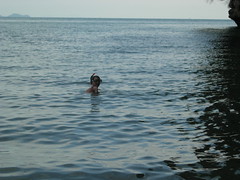
D'oh.


D'oh.
Originally uploaded by Tommy Perkins.
So I'm out snorkeling and I have no idea what I'm doing or what I should be looking for, besides the obvious fish, rocks, coral and such. Jamie gets the camera. The camera is in the same shirt pocket as the ring I'm about to offer her. I look up as she's taking this photo and go under water again. When the realization hit me, my body contorted as thought I'd been electrocuted.

Labels:

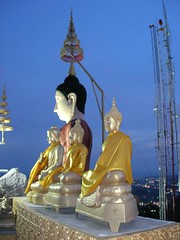
Mountain Shrine Buddhas


Mountain Shrine Buddhas
Originally uploaded by Tommy Perkins.
Jamie and I had marched 1,237 steps up a mountain to see this site and had to hustle to make sunset. Of course, you'd need a fisheye lens to capture a statue so huge, so I had to be creative. This shrine is near Wat Tham Seua, or Tiger Cave Temple, and the views were breathtaking.

Labels:

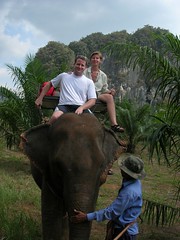
TP and JH atop elephant


TP and JH atop elephant
Originally uploaded by Tommy Perkins.
I had a few caption ideas for this one:
"Sure, an SUV will get you there faster, but, for style, nothing runs like ..."
or
"And here we are atop a mobile Chang brewery."
There's probably something exploitative about this excursion, but I just had a dumb curiosity about elephant trekking. An hour later, I was sated.

Labels:

Signing off from Singapore

[I’d hoped to post this before heading off to Thailand, but I never had the chance. I’ll be following up with more from Thailand and, looking ahead, I hope to discuss more on another passion of mine, digital delivery of music, film and other art. Anyway, here’s what I wrote roughly a week ago upon leaving Singapore for Bangkok:]

Following an eight-hour Powerpoint marathon of presentations (mercilessly, ours came last) at the National University of Singapore and a subsequent “capstone” dinner, things are concluded in Singapore and thus for the school portion of this excursion. So, before I mentally check out for Thailand, I’ll try to divine whatever lessons on this trip that recency permits.

I’m satisfied with our work and feel some indifference about whatever grade we receive. I don’t mean to sound sullen or defiant about this, but I’ve noticed that business school tends to train consultants, rather than managers. No surprise, considering the rate at which MBAs take consulting posts. I guess my thoughts echo those of Henry Mintzberg, whose book, Managers, Not MBAs, I look forward to reading. Still, nowhere is this tendency more evident than in the style-over-substance, analysis-over-action emphases in the average MBA presentation. Business schools are notorious for being havens for Excel and Powerpoint virtuosi who, upon penalty of a Singaporean caning, couldn’t tell you which way is up in the simplest business scenario.

Personally, I suspect a lot of the As I've gotten have been for projects that are still collecting dust on comapanies' shelves (probably deservedly so). So, for a swan song project, perhaps this one will be different.I think our work answered some hard, granular business questions. Our client is considering moving a substantial portion of its hard assets to a third-world country and to address the matter with a 30,000-foot view would be wildly inappropriate. I doubt I need to be disabused: I'm sure we bored people to tears with our detailed risk analysis, in-depth discussion of tax considerations and business entity formations, to say nothing of our extended commentary on what Vietnam’s impending WTO accession implies for business law and accounting standards there.

Apologies for the rant. This really was an exceptional trip and I hope this blog shows how enlightening this experience was for me and how much I enjoyed it. I got close to a lot of classmates with whom my only previous interaction was a nod in the halls at McCombs. I managed to unburden myself of some of my churlish, Western-centric view of the world. I avoided the plethora of illnesses that can wrack a large group of Americans traveling in Southeast Asia.

I look back on all of this with gratitude: to the trip organizers who kept our activities informative and efficient, to my classmates who refused to suffer a dull moment, and to God or whatever divine force that afforded me the mental clarity to get as much out of this as I have. Lastly, thanks to you, the reader, for playing along and offering valuable feedback.

Cheers,
Tommy

Labels:

Wednesday, March 16, 2005

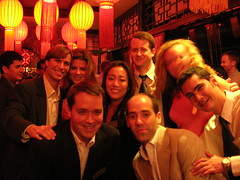
UT Singapore Alumni Event


UT Singapore Alum
Originally uploaded by Tommy Perkins.
Well, apologies to the delightful and talented Yana Kristal on this one, whose headbanging skills, I presume, were quite overstated in this photo. The rest of us looked relatively intact for what turned out to be a rather wet outing. I've been to University of Texas business alumni events in Austin, in a penthouse atop the Wells Fargo Tower in San Francisco's Financial District and, now, at Singapore's China Club. The Eyes of Texas may at times be a bit bleary and cross-eyed, but, I've taken it as an article of faith that they are upon you nonetheless.

Labels:

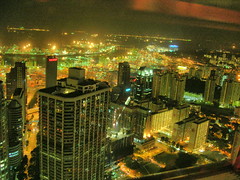
Singapore at night


Singapore at night 3
Originally uploaded by Tommy Perkins.
It is a sparkling city. I'm reminded of Chicago, but with far more daring architecture. I'm not sure that's captured here, but I hope to do the city better justice later on.

Labels:

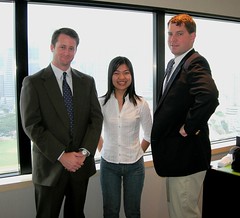
Yours truly, Hong and Charlie


Tommy Hong and Charlie
Originally uploaded by Tommy Perkins.
Again, shot from Singapore's Economic Development Bureau. Hong Le (middle), as mentioned below, is a Vietnamese MBA with the National University of Singapore's Business School and is assisting with our project. Working with these students as has been as much an education as has been any encounter with any of the agencies and companies we've engaged thus far on this trip.

Labels:

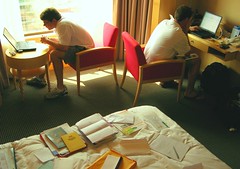
War Room


War Room
Originally uploaded by Tommy Perkins.
We had two double beds stacked with various resources and propoaganda from the countries we'd visited -- inches-thick volumes on country-specific tax codes, business law and a variety of marketing materials from various banks, law firms and government economic development agencies. We were in the process of reconciling that data with feedback we'd gathered from foreign companies we'd interviewed in those countries. To the left, teammate Rand Wrighton, our team's equivalent of the A-Team's Col. John "Hannibal" Smith and a presumptive hedge fund mogul, bangs out a financial model and regional risk profile, while Charlie, aka Capt. H.M. "Howling Mad" Murdock, assembles the powerpoint.

Labels:

Monday, March 14, 2005

Arrival in Singapore

Yesterday evening, we arrived in Singapore, a city/country about which I’ve always had mixed feelings. It’s a city notorious for its Orwellian and antiseptic vibe, but it has its charms as well. I can only give first impressions at this point, which is that the city is well laid-out and features eye-catching ultra-modern architecture at every turn. Singapore obviously invests quite a bit in aesthetics, given its palm-lined boulevards and the bright, lush vegetation along its medians and bridges.

The weather is Houstonian in its mixture of heat and humidity, but the traffic bears no such resemblance. To limit traffic, the government requires Singaporeans to buy a $10,000 permit for car ownership.

Last night our project team met with our counterparts at the National University of Singapore, whose business school is one of the most selective in Asia. Hong Le and Nagajyothi (“Jyo Thi”) Bathula, respectively from Vietnam and India, seemed affable and highly capable.

Hong’s focus is in marketing and her primary charges will be getting us more detail on a government quota scandal in Vietnam that has so far held up that country’s entry into the World Trade Organization, a timetable for the country’s entry into the WTO and an understanding of what WTO entry will mean for stumbling blocks such as quotas, direct hiring, accounting standards, etc.

Jyo Thi, an operations specialist, will gather comparative operations data between Indian and Vietnamese plants. As previously mentioned, Andrews Sport is happy with its operations in India. But Vietnam’s seemingly imminent WTO entry presents an attractive opportunity, as many of the country's clogged, often corrupt bureaucratic processes (most notoriously, its quota system) would have to be drastically streamlined to meet the WTO accession requirements.

At this point, we’ve gathered much of the data we require for our project and our excursion in Singapore will serve mostly to plug the financing gap in our report. Obviously, wealthy Singapore is no candidate for manufacturing, but banks here could offer objective risk analyses of doing business in the countries we’ve discussed and thus give us some sense of the risk premiums that would be assessed to a project in any of these countries.

Last night we wrapped the evening up at The Raffles Hotel, of whose many claims to fame is the invention of the Singapore Sling. This is probably an amateurish comment, but the only differences I could discern between this fruity gin-based drink and a garden variety Hurricane was about $8, an expense largely due to Singapore’s exorbitant liquor taxes. Both are red, sweet and mixed in large five-gallon buckets. Still, the hotel’s historic Long Bar is an attractive, two-storey bar was inspired by Malayan plantations in the 1920s.

Labels: ,

(Unrelated) thoughts en route to Singapore

Oh my land is like a wild goose,
It wanders all around and everywhere
.”

Gram Parsons drawled this airy bit of nostalgia through my iPod on a flight from Penang to Kuala Lumpur and I was suddenly overtaken by a homesickness I’ve felt many times since leaving Georgia nearly eight years ago. In a half-sleep reverie I contemplated longleaf and loblolly pines that reach up to bulbous cumulous clouds. I tasted pulled pork sandwiches drenched in vinegar-based barbecue with steaming sides of Brunswick stew, sublimely sweet peaches, salty boiled peanuts that melt in your mouth like chocolate. And grits, that blessed delicacy colloquially known as Georgia Ice Cream, a versatile dish that, depending on the meal and the ingredients, can supplant cous-cous, rice, oatmeal and more. I thought of the long, flat stretch of Corridor Z that carried my family every summer past South Georgia’s cotton fields and peach orchards to St. Simons Island and Sea Island, both of which have long since given way to multimillion-dollar developments. The thrill of bourbon-soaked fall football Saturdays coursed through my synapses. I also thought of a wet heat, much like the one here, that envelops you like a loving but overbearing mother.

Billboards and truckstops passed by the grievous angel.
Now I know just what I have to do.

Nostalgia wafts through the mind like ether, bathing the brain in warm recollections, all the while dousing it with delusions about the past. I suppose it is with some cocktail of stoic pride and sheer necessity that I knock back this kind of sentiment. Thomas Wolfe’s admonition about going home usually holds true, but I’m not sure it’s axiomatic. The way I’ve previously read his comment, it’s an observation that you can’t hold time, space and circumstances constant. Even if you could, why would you? The three likely were never as good as you remembered them and, regardless, you’ve still grown older and, one hopes, wiser. Thus, you would be hopelessly out of place. It’s a pointless scenario to consider.

But a crisis in my family has taught me the contradiction implicit in Wolfe’s statement: You must go home again. Because circumstances don’t stay constant, you must tend to that garden of friends and family, clear the weeds (or kudzu, in my family's case) and renew the ties that bind. After a stretch that’s taken me through both Carolinas, from Tennessee to Texas and to California and back, I feel that obligation more strongly than ever in my life. I used to joke that, when God places his hand on you, it usually hurts like hell. Job, the Jews and Jesus Christ could all attest to this. But there’s a lot of growth that comes from pain, just as there’s a lot of wisdom that comes from taking stock of one’s ignorance. So I’ve been getting a fair dose of both phenomena as I approach my 30th year on earth and no doubt it's about damned time.

Labels:

Penang, Day 2

While walking on the south end of the beach at Penang, I encountered an ex-pat Malaysian man now residing in the UK. A warm and funny old guy, he noted my Vietnam infantry hat and jokingly asked if I was still fighting the war. We talked for a while and I’m somewhat annoyed with myself that I didn’t get a photo of the man.

He offered several insights that helped shape my impression of Malaysian multiculturalism, particularly as it affects the country’s economy. We were discussing my client’s prospects for outsourcing textile manufacturing and he pointed out how the balance of ethnic power in Malaysia would play a role in hiring, although I later learned during a tour of Dell’s facilities in Penang that these rules applied to public institutions, such as government agencies and universities. Roughly 30% of managers must be Malaysian, and that means of Malay descent, rather than nationalized Malaysians including ethnic Chinese, Indians, Indonesians, etc. Such rules represent an interesting nuance in globalism. Every country has its own take on economic protectionism, particularly as it relates to the bull in the global economic China shop that is China, and this, I reckon, is Malaysia’s version of it.

The old man and I talked for a while longer about the trade imbalance between the US and its Asian partners and much of the discussion centered on China as an economic force of nature and of the attempts by smaller Southeast Asian countries, like Vietnam, to hem in the red bull or, at best, withstand its onslaught. It seems undeniable that this century could see the US cede its global hegemonic status to China as an expanding middle class there gets a taste for open consumerism and thus capitalism. The persistent tension is whether the country can liberalize quickly enough to accommodate its burgeoning middle class.

In Malaysia, he observed, much of the capitalist-style individual competition is driven hardest by ethnic Chinese, an irony considering the Malay contempt for communism. Perhaps that’s not so ironic, if you place that phenomenon in the context of the historically aggressive industriousness of US immigrants, who account for the vast portion of entrepreneurial activity stateside.

At Dell’s facilities, we learned quite a bit about the labor environment in northern Malaysia. Vigorous competition for foreign direct investment exists not only at the national level, but also at the state level. Think of the concessions afforded to Mercedes, Nissan and BMW by, respectively, Alabama, Mississippi and South Carolina. Presumably states hope to make up the concessions from the rising tax base. While it was unclear if incentives are targeted at specific industries, the state of Penang has attracted more than its share of technology companies, such as Dell and Sony. Following a labor crunch in the early 1990s, competition for labor seems to have stabilized as the local population surged to meet the demand. At Dell’s factory, which churns out 35,000 products a day – mostly laptops – (48 per worker per day, not counting overtime), annual salaries for line workers begin at $700, although that can vary greatly, as overtime can average 30 hours a week with hourly rates averaging 1.5x to 2x standard rates.

Sweatshop activists and outsourcing opponents will likely howl at such rates, but my fellow beachcomber, a native of Malaysia’s rural countryside, expressed amazement at how the country’s newfound wealth had trickled through to his birthplace, where new construction and homebuilding had rendered the area almost unrecognizable to him. To be sure, all the old forms of commerce predominate – everything from fishing to guava juice stands, but it’s impossible to ignore how the inflow of money from sons and daughters working everywhere from local factories to abroad in Japan and the US has catapulted the region’s standard of living. “Vietnam will learn,” he observed.

Labels: , ,

Sunday, March 13, 2005

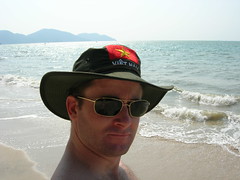
Ho-kah Hey!


TP beach 1
Originally uploaded by Tommy Perkins.
A friend of mine, Stanley, said I had a Hunter S. Thompson look about me this day. I had a friend who ate his gun about 10 years ago and I wonder about others who are, in a sense, doing so passively. Enough about that.
It was a beautiful day and if I could have been shot through a cannon across any harbor, why not this one? "Ho-kah Hey," as I recall from Larry McMurtry's biography of Crazy Horse, is the Oglala Sioux cry for "Today is a good day to die" and was the ascetic warrior-hero's pronouncement before cascading on Custer's brigade.
Anyway, a cloudless sky bathed an otherwise empty Malaysian beach. A fine day, indeed.

Labels:

Lunch in Ipoh


chickens dangling 1
Originally uploaded by Tommy Perkins.
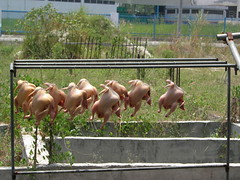
Some days are just weird all around. We'd just been touring a coffin factory (more on this later) in Ipoh, Malaysia, and were having lunch with the proprietors, when I stepped out to the loo to happen upon this site. Incredibly, I finished matters in the washroom and finished my meal. I like to think it's a virtue, but it takes a lot to gross me out when I've gone without breakfast, which obviously was the case the day I shot this gem.

Labels:

Combing Penang, pt. 2


TP and local ladies
Originally uploaded by Tommy Perkins.
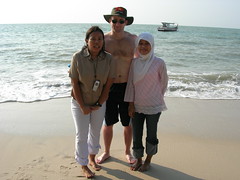
This group of women came screaming up to me, demanding photos. Naturally, a bit of reciprocity was in order. I think they thought I'm Australian.

Labels:

Combing Penang


Fishermen 1
Originally uploaded by Tommy Perkins.
Cake eating doesn't photograph well, so after a few drinks with classmates at the Shangri-La's beach resort, boredom set in and I began exploring the stretches of beach that extend beyond Penang's resort areas.
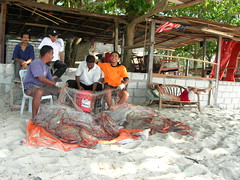
This group of fishermen were delighted to take a break from plucking the fruits of the sea from their net to have their photo taken and the gentlemen at the far right seemed to be in much the same shape as my colleagues at the pool.

Labels:

Saturday, March 12, 2005

Last day in Kuala Lumpur


KL Street Scene 3
Originally uploaded by Tommy Perkins.
Our last night in KL followed a round of Rusty Nails at the Marriott and began with a stroll through Chinatown, which, as best as I could tell, exists almost exclusively as a market for pirated goods. Although the satay and fruit stands and the non-existence of open container laws make this area a feast for the feast for the senses, provided one has a tolerance for intense open air hawking and haggling.

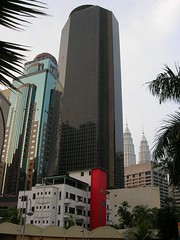
Earlier in the day, I went for a walkabout in KL's Golden Triangle with my new camera, in hopes of capturing interesting street scenes and to document architecture beyond than the two landmarks for which the city is justifiably famous, the Needle and the Petronas Towers.

KL is an exceedingly safe town, although the traffic that careens around the city's winding and perpetually merging streets, coupled with limited sidewalks, lend the city less to walking than do cities like Saigon, Rome or New York.

As a former photojournalist, I'€™m still quite conditioned to the notion that anything in open air is fair game for shooting, and, given this region’s willingness to sacrifice privacy for security, I took to KL’s as though it were public gamelands. I still feel that way about the city, although an altercation with one man gave me cause to reconsider my position.

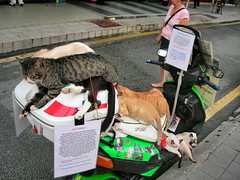
The owner of a parked motor scooter had about a dozen homeless cats dozing all over his bike, with a sign attached that solicited passers-by to provide homes for the felines. There were some really gorgeous Siamese among the cats and I stopped to snap a few shots, before politely nodding to the bike owner and walking off.

I have a really tortured appreciation for cats, in that I find them to be quite beautiful, affectionate and intelligent animals. But my allergies and my pit bull rule out any room in my life for these creatures.

Regardless, within less than a minute, another man nearby chased me down and demanded that I delete the photos.

Taking a page from Charlie's book, I feigned ignorance via an maddeningly halting Russian accent. One of the things I've learned traveling is that Americans unwittingly walk around with neon signs above their heads that exhort locals to take advantage of them and their gobs of cash. Given such realities, I find it is always best to pretend to be of some other nationality whose language I am confident no local would have bothered to learn. Sometimes it’s French, sometimes some Slavic-Russian combo, sometimes it’s my native Georgia Redneck.

This time, I sputtered Russian-sounding gibberish at my accoster and pretended not to know how to operate the camera (Agh ... ugh ... I heef buy theesz ... agh ... to-deee, yeesz?€). Finally, the poor bastard realized that this was a competition to see who could waste the most of the other’s time and that I was bound to win this war of attrition.

Notwithstanding that encounter, seeing the KL by foot affords an extraordinary glance at a city that is multicultural to a degree that renders such boasts by American metropoli laughable. Draped Muslim women stroll past an endless array of Chinese restaurants, while dark-skinned Indians and Pakistanis man the doors of gleaming new hotels. Elsewhere, Maylay, Japanese, Australians and countless other ethnic groups mill about the area’s shopping districts.

Later that night, a cab driver who claimed to be of the same clan as the ousted Taliban of Afghanistan talked at length about the virtues of KL as a multicultural city. The notion that separation of church and state is anathema to any predominately Muslim society is exposed as a myth in Malaysia. The country government is a constitutional monarchy and the driver touted cultural mixing as a real point of pride here. He predicted that the prolific ethnic mixing would, in a generation, result in a unique, ethnically homogenous society that contained strains of every race in Asia and Australia.

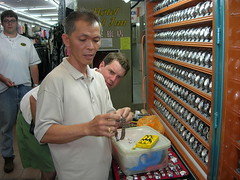
Back in Chinatown, the air was perfumed with the carcinogenic delights of a hundred satay stands and the fruits of the land were represented abundantly at dozens of markets, but the primary commodities the packed district are pirated DVDs and CDs, imitation Rolex and Cartier watches and all manner of imitation brand name leather bags and apparel. It's a marvelous place to test one's bargaining abilities. I was initially pleased at having settled at $17 for a stainless steel Rolex Explorer II. Buyer’s remorse, valid or not, inevitably follows such transactions, but given the types of prices pitched to Americans, who are widely presumed to have vastly more money than street wisdom, I felt good about the deal. Fellow travelers experienced in such things agreed the watch was in relatively good shape for a fake and I took some strange comfort in seeing the salesman’s prodigious array of tools next to his wares. Compared to the other hucksters in the market, my salesman was a veteran, blessed with a kind face, a rare patience with the process and a genuine sense of pride about the quality of his fakes.

Later we proceeded to Passage to India, one of the city's many delicious offerings of Indus fare, before heading to one of an inexplicably large number of Cuban-themed bars in this city. Almost as inexplicable is the absolute dearth of Meyers Rum in these places. Watching large quantities of East Asians salsa en masse to an all-Asian Latin group is truly one of those "Lost in Translation"€ moments where a relatively giant gringo like me struggles helplessly to make sense of a scene of mind-bending cultural absurdity.

The next day at 7 a.m. we had to depart the Ritz post-haste to take a bus ride to Penang. Estimations ranged from four to eight hours. Planned visits included a coffin manufacturing factory. More strangely, given our program’s proximity to Dell’s headquarters in suburban Austin (Round Rock), a visit to a Dell factory is also on tap. Now don't get me wrong: As a student of business, it's hard for me to regard Dell with anything less than admiration for the way its direct model practically rival Gutenberg's Bible and Henry Ford's first car factory for revolutionizing the relationships between operational efficiency and cash flow management. But it takes the average Texas MBA less than one semester before he's damn near intellectually constipated by Dell Holy Writ in the form of endless case studies on the company.

Labels:

Chinatown Rolex dealer 1

I was initially pleased at having settled at $17 for a stainless steel Rolex Explorer II. Buyer’s remorse, valid or not, inevitably follows such transactions, but given the types of prices pitched to Americans, who are widely presumed to have vastly more money than street wisdom, I felt good about the deal. Fellow travelers experienced in such things agreed the watch was in relatively good shape for a fake and I took some strange comfort in seeing the salesman’s prodigious array of tools next to his wares. Compared to the other hucksters in the market, my salesman was a veteran, blessed with a kind face, a rare patience with the process and a genuine sense of pride about the quality of his fakes.


Chinatown Rolex dealer 1
Originally uploaded by Tommy Perkins.

Labels:

Homeless Cats


Homeless Cats 3
Originally uploaded by Tommy Perkins.
The owner of a parked motor scooter had about a dozen homeless cats dozing all over his bike, with a sign attached that solicited passers-by to provide homes for the felines. There were some really gorgeous Siamese among the cats and I stopped to snap a few shots, before politely nodding to the bike owner and walking off.
I have a really tortured appreciation for cats, in that I find them to be quite beautiful, affectionate and intelligent animals. But my allergies and my pit bull rule out any room in my life for these creatures.
Regardless, within less than a minute, another man nearby chased me down and demanded that I delete the photos.
Taking a page from Charlie's book, I feigned ignorance via an maddeningly halting Russian accent. One of the things I've learned traveling is that Americans unwittingly walk around with neon signs above their heads that exhort locals to take advantage of them and their gobs of cash. Given such realities, I find it is always best to pretend to be of some other nationality whose language I am confident no local would have bothered to learn. Sometimes it’s French, sometimes some Slavic-Russian combo, sometimes it’s my native Georgia Redneck.
This time, I sputtered Russian-sounding gibberish at my accoster and pretended not to know how to operate the camera
(“I … ugh …. I heef buy theesz … agh … to-deee, yeesz?”). Finally, the poor bastard realized that this was a competition to see who could waste the most of the other’s time and that I was bound to win this war of attrition.

Labels: